China Top 10 Discovery Chemistry Service Providers?
China’s discovery chemistry market is becoming a practical engine for global drug research. The work spans hit identification, medicinal chemistry, molecule optimization, and early developability testing. According to the IQVIA Institute’s Global Trends in R&D 2024, global biopharma research spending exceeded $140 billion in 2023. That investment increases demand for reliable, scalable Discovery chemistry service partners.
China offers dense scientific talent and increasingly integrated laboratory infrastructure. Strong providers may combine automated synthesis, parallel chemistry, analytical testing, and project-based medicinal chemistry. A vial rack, a confirmed LC-MS result, and a clear weekly report often reveal more than promotional claims. As Exscientia founder Andrew Hopkins has stated, “The future of drug discovery is digital.” His observation highlights the growing role of data, automation, and predictive design in modern chemistry.
This article reviews ten leading China-based providers using practical criteria. These include technical breadth, project experience, turnaround discipline, communication quality, intellectual-property safeguards, and publicly documented capabilities. The list should not be treated as an absolute ranking. Service quality can vary by therapeutic area, molecule complexity, and project stage. That limitation matters.
Some companies excel at rapid compound generation. Others provide deeper medicinal chemistry strategy or integrated biology support. The strongest choice depends on the scientific question, not only the company’s size. Readers should verify current facilities, regulatory practices, scientists, and references before signing a project. This introduction offers a useful starting point, but it cannot replace technical due diligence.
What Is Discovery Chemistry and Why Does It Matter in China?
Discovery chemistry is the stage where promising biological ideas become measurable, testable molecules. In China, it connects medicinal chemistry, analytical science, process development, and early safety evaluation. The work often begins with a target profile, a small compound library, and several uncertain assumptions.
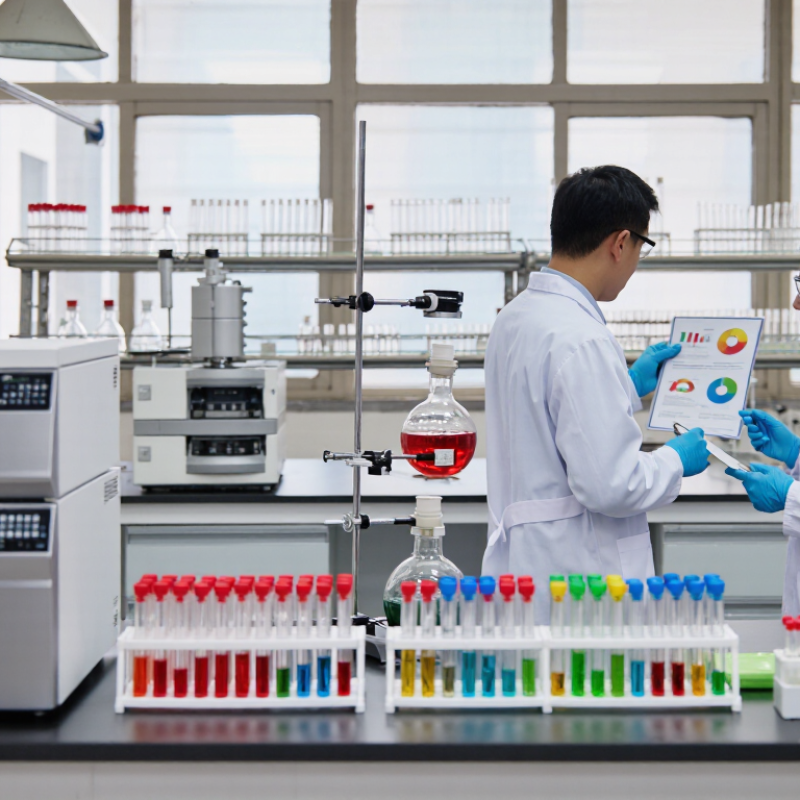
A capable discovery chemistry team can design compounds, prepare analogues, and interpret results quickly. It may use 96-well reaction plates, LC-MS checks, NMR confirmation, and chiral analysis. These details matter. A molecule that looks successful on paper may show weak stability, poor solubility, or an unexpected impurity. Small changes can decide whether a program advances.
China’s research environment adds practical value through strong technical talent, expanding laboratory infrastructure, and efficient supply networks. Local expertise can also support bilingual records, traceable sample management, and documentation aligned with international development expectations. Reliable providers should explain failed reactions, not hide them. They should protect data integrity and question unrealistic timelines.
Chemistry is rarely linear.
A thoughtful partner tests assumptions early. For example, it may compare several synthetic routes before scaling one approach. It may also examine salt forms or solid-state behavior before a formulation problem appears. Still, no provider can remove every uncertainty. Some decisions remain based on incomplete evidence, and that limitation deserves honest discussion. Discovery chemistry matters because it turns uncertainty into organized evidence, one experiment at a time.
China’s Top 10 Discovery Chemistry Service Providers
China’s Top 10 Discovery Chemistry Service Providers should be assessed by capability, not visibility alone. A credible provider needs experienced medicinal chemists, traceable records, and clear project communication. The strongest teams usually support hit generation, analog design, compound synthesis, purification, and analytical confirmation. They should also explain limitations before work begins.
A practical top-ten shortlist may include providers specializing in parallel synthesis, fragment chemistry, scaffold expansion, chiral separation, fluorine chemistry, and route scouting. Others focus on library design, computer-aided compound selection, bioassay support, or process transitions. Useful evidence includes LC-MS data, NMR spectra, purity reports, electronic laboratory records, and secure sample tracking. In real projects, a 96-well plate may reveal a promising trend, while a later 2-gram synthesis exposes poor solubility. Small details matter.
Experience is visible in how a team handles failed reactions. Reliable chemists do not hide low yields or questionable structures. They propose alternatives, record deviations, and protect confidential information. Independent audits and documented quality systems add authority, especially for programs entering regulated development. Yet rankings remain imperfect. Public information is uneven, and service quality can vary between project teams. A provider that excels at rapid analog synthesis may struggle with difficult scale-up. Clients should review recent case evidence, response times, analytical depth, and ownership of intellectual property before selecting among China’s leading discovery chemistry service providers.
What Services and Technologies Do These Providers Offer?
China’s top ten discovery chemistry service providers increasingly support the full early-stage pipeline. Their work often begins with target assessment, literature mining, and structure-based design. Chemists then build focused compound libraries through parallel synthesis, scaffold hopping, and reaction optimization. Some facilities can deliver hundreds of purified compounds each month, with analytical data attached.
Modern platforms combine medicinal chemistry with high-throughput screening, ADME testing, and computational modeling. Liquid chromatography–mass spectrometry checks purity and molecular weight. Nuclear magnetic resonance confirms structural identity. Several providers also use automated synthesis, fragment screening, and machine-learning models to prioritize promising candidates. A 2024 review in Nature Reviews Drug Discovery noted that artificial intelligence is increasingly used for molecular design, but experimental validation remains essential. Algorithms can suggest attractive structures. They cannot replace chemical judgment.
The 2024 Global Trends in R&D report recorded 53 novel active substances launched globally in 2023, showing continued pressure on discovery productivity. A 2023 industry analysis estimated that artificial intelligence could create tens of billions of dollars in annual value across pharmaceutical research. Chinese service teams respond with flexible project models, from single-route synthesis to integrated hit-to-lead campaigns. They also provide kilogram-scale process chemistry for selected molecules. Yet speed may hide weaknesses. Incomplete assay translation, inconsistent data standards, or rushed scale-up can undermine a promising program. Experienced buyers should examine raw data, reproducibility, impurity control, and communication practices—not only compound counts.
China’s Top 10 Discovery Chemistry Service Providers: Service and Technology Coverage
This chart summarizes the number of leading China-based discovery chemistry providers commonly offering each major service or technology. The figures represent provider coverage within a 10-provider benchmark and are intended to show market capability concentration rather than rank individual companies.
Medicinal chemistry and custom synthesis are the most widely available capabilities, while advanced platforms such as DNA-encoded libraries, PROTAC-focused discovery, and fragment-based screening are offered by a smaller but growing group of specialized providers.
How Can Clients Select the Right Discovery Chemistry Partner?
Choosing among China’s top ten discovery chemistry service providers requires more than comparing hourly rates. A suitable partner should prove technical depth, transparent communication, and reliable project control. IQVIA Institute’s Global Trends in R&D 2024 reported more than 22,000 active biopharma pipeline programs in 2023. That scale makes speed valuable, but reproducibility matters more. Review hit-to-lead results, route scouting records, analytical methods, and impurity investigations. Ask whether the same senior chemists will remain involved. Confirm data integrity, intellectual property ownership, confidentiality, and applicable regulatory responsibilities before signing.
Tips: Request three anonymized case studies. Check raw LC-MS and NMR examples. Define measurable milestones, such as compound delivery time, purity, and success rates. Do not trust slides alone. A polished proposal can still hide weak chemistry. Also examine failure reporting. Honest partners explain why a route failed and how they changed direction. Deloitte’s 2024 Measuring the Return from Pharmaceutical Innovation report estimated the average forecast return on biopharma R&D investment at about 5.9%. That figure reinforces the need to control rework and protect project decisions with evidence.
Clients should compare scientific judgment, not only catalog breadth. Ask for a pilot project with clear acceptance criteria. Evaluate the laboratory’s documentation, communication rhythm, and escalation process. Site audits can reveal practical details, including instrument availability, sample labeling, and waste controls. No scorecard is perfect. However, a structured review reduces costly surprises and helps distinguish genuine discovery capability from attractive presentation material.